12 Latte Art Beginner Drinks You Can Actually Make at Home
Here is a truth nobody tells you when you first get obsessed with coffee: the fancy hearts and rosettas you see on Instagram are not the result of magic, talent, or a $3,000 espresso machine. They are the result of making the same terrible blobs over and over until muscle memory kicks in and something vaguely leaf-shaped emerges from your cup. That is the whole story.
I spent three weeks destroying perfectly good oat milk before I poured a heart that looked intentional. During that time, I discovered that the drinks you practice on matter enormously. Some lattes are actually designed in a way that makes latte art easier to learn — the milk ratio, the espresso dose, the cup shape all conspire either for you or against you. Pick the wrong drink to start with and you will frustrate yourself into giving up before you ever see real progress.
So here are 12 latte art beginner drinks chosen specifically because they teach you something useful. Each one builds a skill. By the time you work through all twelve, you will have poured every foundational technique there is. No barista training, no wasted coffee tuition. Just a list, an honest breakdown, and the occasional moment of “wait, that actually worked.”

Why Latte Art Starts With the Right Drink, Not the Right Technique
Most people learn latte art backwards. They watch a tutorial, try to copy the hand movement, then wonder why their milk just sinks into the espresso like it has somewhere better to be. The hand technique is actually the last piece of the puzzle. Before any of that matters, you need the right espresso crema, the right milk texture, and the right drink volume. These three variables do most of the work for you.
A classic six-ounce latte gives you a much more forgiving canvas than a twelve-ounce. The smaller volume means your foam does not have to travel as far, which makes those early attempts at a heart look far more convincing. Similarly, drinks with a strong espresso base — like a cortado or a macchiato — keep the crema thick and buoyant, which literally holds your foam pattern on the surface while you figure out what you are doing.
As the team at Prima Coffee explains in their complete guide to pouring latte art, pour speed, proximity to the cup, and spout placement are the three fundamental factors that drive every design. Getting familiar with those factors through forgiving beginner drinks is exactly how you build real intuition, as opposed to white-knuckling your way through a complicated design on a massive flat white.
The drinks below are organized loosely from most forgiving to most instructive. Start from the top if you are a complete beginner. Jump around if you already have some muscle memory and want to target a specific skill gap. Either way, every single drink on this list is something worth drinking while you practice.
The 12 Best Beginner Drinks for Learning Latte Art
The Classic Six-Ounce Latte
This is the one. If you could only practice on a single drink for a month, make it this. A six-ounce latte built on a double shot of espresso gives you just enough volume to see a pattern emerge without the extra milk working against you. The golden ratio here is roughly two ounces of espresso to four ounces of steamed milk, which keeps the crema thick and the foam buoyant.
Your goal on this one is the heart. Pour from about ten centimeters above the cup to fill the base, then lower the pitcher to the surface and wiggle slightly before a final push-and-cut forward. It will look terrible the first time. Drink it anyway. Then pour another.
- Target design: Basic heart
- Skill practiced: Pour height and milk-to-crema ratio
- Cup: Round, wide-rimmed, 6 oz ceramic
20 coffee latte recipes you can make without a machine Get Full Recipe
Oat Milk Latte
Oat milk has quietly become the barista’s favorite non-dairy option, and for good reason. When steamed correctly, oat milk produces a microfoam that is almost as cooperative as whole milk — silky, dense, and slow-moving enough to give you time to think. That extra half-second of working time is genuinely valuable when you are still figuring out the relationship between your wrist and the pitcher.
The key is not to over-aerate. Oat milk goes foamy fast. You want velvety and pourable, not a stiff meringue situation. Keep the steam wand just below the surface, incorporate the air quickly, then let the heat do the work. If you want to explore non-dairy options further, there are some great non-dairy coffee recipes using almond, oat, and coconut worth trying alongside your practice sessions.
- Target design: Heart, then a stacked tulip
- Skill practiced: Controlling non-dairy foam texture
- Note: Barista-grade oat milk performs significantly better than grocery-store carton
Steam your milk to around 55 to 60 degrees Celsius. Too cool and the foam will not integrate; too hot and you kill the sweetness and the texture goes grainy. A clip-on thermometer like [Thermapen-style instant-read thermometer] removes all the guesswork while you are still calibrating your instincts.
Flat White
The flat white is the drink that separates people who think they can do latte art from people who actually can. A four-ounce flat white uses the same double shot as the latte, but with significantly less milk. This means your margin for error is about half what it is on a standard latte, and any wobble in your pour shows up immediately. Which, counterintuitively, makes it fantastic for learning.
Because the canvas is smaller, even your failures give you crisp feedback. A slightly off-center heart on a flat white reveals your pour-angle problem far more clearly than the same mistake diluted across eight ounces of milk. Think of it as training in a smaller ring.
- Target design: Heart, then rosetta when confident
- Skill practiced: Precision and volume control
- Cup: 5 to 6 oz tulip-shaped cup
Classic Cappuccino
The cappuccino introduces you to working with thicker foam — the kind that moves slowly, requires more pour force, and teaches you how to use weight and momentum rather than just wrist control. Traditional cappuccino foam sits somewhere between latte microfoam and the stiff stuff you get from a French press. Getting a clean pattern on a cap requires you to force the foam across the crema surface, which builds a kind of physicality to your pour that translates beautifully to every other drink.
Work on a simple three-layer tulip here. Pour, pause slightly, pour again, cut forward. The pause is where most beginners struggle — they keep pouring continuously out of nerves — but that brief stop is what creates the distinct petals that make a tulip look intentional.
- Target design: Three-layer tulip
- Skill practiced: Pausing and layering the pour
Cortado
Equal parts espresso and steamed milk, four ounces total. The cortado is a brutally honest drink. There is no hiding behind extra milk volume, and the high espresso-to-milk ratio means your crema is thick, dark, and unforgiving. Pour wrong and you sink the foam immediately. Pour right and you get a sharp, high-contrast design that photographs beautifully.
What makes the cortado genuinely useful for beginners is that it trains you to work fast. You have a small window before the crema starts to break down, which forces the urgency and decisiveness that good latte art requires. Think of it as a timed drill.
- Target design: Simple heart with strong contrast
- Skill practiced: Speed, decisiveness, working under crema pressure
- Glass: Small 4 oz glass for visual feedback on milk depth
25 easy homemade coffee recipes to try this week Get Full Recipe
Matcha Latte
Yes, matcha. Hear me out. The matcha latte is one of the best practice drinks for latte art beginners because the vivid green base creates instant visual contrast that shows you exactly where your foam is landing. You can see the foam floating on top the moment it hits the surface, which gives you real-time feedback that dark espresso simply cannot replicate at the same level.
Beyond the visual advantage, matcha lattes have a slightly thicker base consistency than espresso, which means your foam has a more buoyant surface to ride on. FYI, ceremony-grade matcha is not required for this — culinary grade is fine for practice. You are learning a skill, not hosting a Japanese tea ceremony.
- Target design: Heart, then a simple leaf/rosetta
- Skill practiced: Reading foam placement in real time
- Bonus: The high-contrast visuals make for excellent practice photos
Vanilla Latte
Adding vanilla syrup to your practice latte does something interesting: it makes the milk slightly sweeter and marginally thicker, which can give you a fraction more working time before the foam loses its integrity. That might sound trivial, but when you are building muscle memory, even an extra half-second of grace period helps. You can use store-bought syrup or make your own — there are some excellent homemade coffee syrup recipes worth bookmarking if you want to control your ingredients and skip the artificial sweeteners.
More importantly, vanilla lattes are pleasant enough to drink in the quantity you need for real practice — and that quantity is more than you think. Some days you will pull six shots and practice six pours. Having a drink you actually enjoy makes that process considerably less miserable.
- Target design: Tulip, then a five-layer stacked tulip
- Skill practiced: Layering technique with a slightly more forgiving medium
Whole Milk Classic Latte (8 oz)
When you are ready to move up in volume, the eight-ounce whole milk latte is the next step. Whole milk produces the most consistently cooperative microfoam of any milk option because of its fat and protein structure. Whole milk fat helps stabilize the foam and integrate the microfoam evenly, which means fewer bubbles, smoother flow, and cleaner designs.
Use this drink to practice the rosetta. The extra volume gives you room to build multiple wiggle-strokes across the surface, and the cooperative foam makes it far more likely that those strokes will actually show up. A [stainless steel latte art pitcher with a sharp pointed spout] makes a noticeable difference here — the spout shape directly controls how much foam you release versus how much stays back, and a good pitcher is honestly one of the best investments a beginner can make.
- Target design: Rosetta
- Skill practiced: The wiggle-and-draw technique for leaf designs
Before you pour, give your milk pitcher a firm tap on the counter and then swirl it for five seconds. This pops surface bubbles and integrates the foam evenly — two moves that cost nothing and visibly improve every single pour.
Honey Cinnamon Latte
This is a slightly more advanced beginner drink, but it belongs on this list because it teaches you to work around flavoring without letting it sabotage your pour. Adding honey and cinnamon to the espresso base before you pour changes the surface tension just enough to make you recalibrate. Small disruptions to the canvas teach you to adapt your technique in real time, which is exactly what you need before moving to more complicated drinks.
From a flavor standpoint, the combination of honey sweetness and cinnamon warmth with a rich espresso base is genuinely excellent. If you are going to practice ten or twelve pours in a session, you might as well be drinking something that makes the process enjoyable.
- Target design: Heart with higher pour-rate for contrast
- Skill practiced: Adapting to surface disruptions
12 healthy coffee recipes with nut milks and natural sweeteners Get Full Recipe
Coconut Milk Latte
Coconut milk behaves differently from both oat and dairy, and learning its particular quirks is worthwhile. Full-fat coconut milk from a can (not the refrigerated carton) froths well and produces a foam that is slightly denser and slower-moving than oat milk, with a subtle sweetness that plays beautifully against espresso. The challenge is that it separates quickly once frothed, so you have to move with intention.
This drink teaches urgency without the brutal feedback of the cortado. You have a generous canvas, but your foam has a shorter shelf life, which nudges you to commit to your design faster. IMO, this is one of the most underrated practice drinks on the list precisely because of that tension.
- Target design: Simple heart or tulip
- Skill practiced: Committing to the pour under time pressure
- Tip: Use full-fat canned coconut milk, not the carton variety
Mocha Latte
Chocolate changes the espresso base completely. Adding chocolate syrup or melted dark chocolate to the espresso before pouring gives you a darker, richer, more viscous canvas that behaves differently from straight espresso crema. The surface tension shifts, the color contrast increases, and your foam patterns show up with dramatic clarity. This makes the mocha excellent for learning to read your own pours.
At this stage you should be practicing rosettas and attempting your first swan designs. The mocha’s high-contrast surface helps you see exactly where your technique breaks down — whether your wiggle is consistent, whether your pull-through is clean, whether you are cutting at the right moment. A [fine-tip latte art pen for etching details] comes in handy here if you want to clean up edges or add fine lines to your designs while you work on getting the pour itself consistent. For more chocolate-forward inspiration, the coffee and dessert pairing ideas are worth exploring.
- Target design: Rosetta, swan attempt
- Skill practiced: Reading designs against high-contrast surfaces
Use a round-bottomed cup with a wide mouth for every practice session. Cylindrical cups and narrow openings fight you at every step. Wide, rounded cups like those used in most specialty coffee shops are specifically shaped to work with microfoam physics — they are not a style choice.
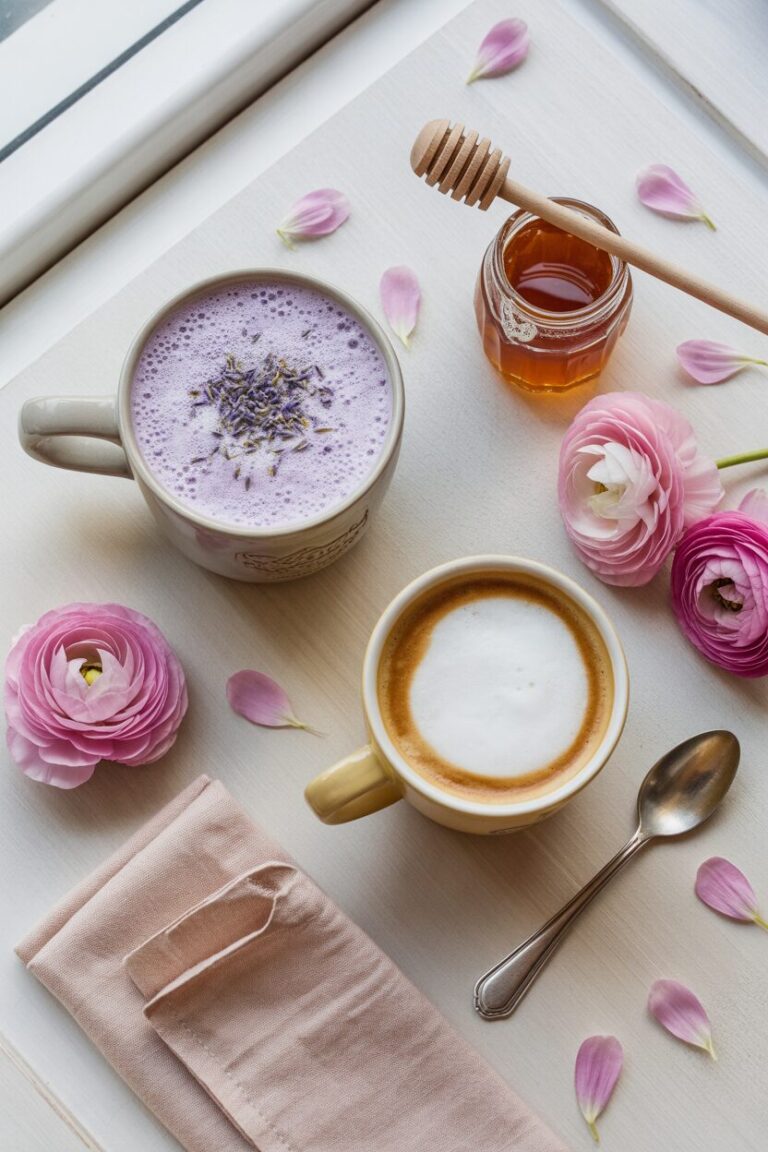
Lavender Oat Milk Latte
The final drink on this list is a reward and a challenge simultaneously. Lavender syrup in an oat milk latte produces a pale purple-grey canvas with a subtle floral aroma that makes the whole practice session feel somewhat less like manual labor. More importantly, the combination of oat milk behavior and lavender syrup viscosity creates a surface that rewards slow, controlled pours — exactly the skill you have been building across the previous eleven drinks.
By the time you get here, your heart should be consistent. Your tulip should be clean. You are probably landing a rosetta every third pour. The lavender latte is where you try that swan you have been watching on YouTube, because the cooperative surface and the forgiving foam mean you have the best possible conditions for success. There are some genuinely beautiful latte recipes you can make without a machine if you want to extend this exploration further.
- Target design: Swan or advanced tulip
- Skill practiced: Applying everything you have learned with precision
- Reward level: Very high. Treat yourself.
Tools That Actually Make a Difference
These are the things I reach for regularly. No fluff — just what genuinely helps when you are learning from scratch.
Stainless Milk Pitcher
12 oz with a sharp pointed spout. The spout shape is not decorative — it controls foam flow directly.
[Stainless Steel Latte Art Pitcher 12oz]Digital Milk Thermometer
Clip-on style that reads in seconds. Until you can judge temperature by touch, this is your best friend.
[Instant-Read Clip Thermometer]Wide-Mouth Ceramic Cups
Round-bottomed, 6 oz. The cup shape genuinely affects how foam flows across the surface.
[Set of 4 Latte Art Cups 6oz]Latte Art Grading System Course
A structured online program that takes you from beginner to certified — at your own pace.
[Latte Art Online Course]Pour Tracking Journal Template
A printable PDF to log each practice session — what worked, what did not, and what to try next.
[Latte Art Practice Journal PDF]Espresso Ratio Calculator
A browser-based tool for dialing in your dose, yield, and timing for any espresso machine.
[Espresso Dial-In Tool]The Milk Science You Actually Need to Know
You do not need a chemistry degree to understand what makes microfoam work, but knowing the basics will save you weeks of frustration. Milk is made up of water, fat, protein, and sugar. When you introduce steam, two things happen simultaneously: the proteins denature and stretch to form a foam network, and the fats melt and lubricate that network to make it silky rather than stiff. This is why fat content matters so much in latte art milk.
Whole milk (around 3.5% fat) gives you the most cooperative foam because the fat content is high enough to produce excellent lubrication without being so high that it prevents the foam from integrating. Reduced-fat milks produce more foam but less stability. Skim milk makes a voluminous but brittle foam that shatters when you try to pour it into a design. Understanding this hierarchy helps you choose the right practice medium for where you are in your learning.
Non-dairy milks follow a different set of rules. Oat milk relies on beta-glucan (a type of soluble fiber) to mimic the emulsifying properties of dairy protein. Soy milk uses isoflavone proteins. Barista editions of these milks have been specifically formulated to steam closer to whole milk behavior — they are generally worth the price premium when you are learning. According to research published by food scientists studying milk foam stability and microfoam structure, protein content and fat distribution both independently affect the quality and longevity of steamed foam — which explains why barista-grade non-dairy milks behave so differently from their standard equivalents.
If you want to explore the low-calorie side of latte creation, there are some great coffee drinks under 100 calories that still allow you to practice the art without the full-fat commitment every single session.
The Six Mistakes Every Beginner Makes (and How to Stop Making Them)
Pouring From Too High for Too Long
Starting high is correct — it lets the milk sink below the crema to build volume. But staying high throughout the pour means your foam sinks the entire time and never surfaces to form a pattern. The transition from high to low is where the design begins. Most beginners hold the pitcher too high for comfort and wonder why nothing appears on top.
Not Enough Milk in the Pitcher
If you fill the pitcher barely a third full, you will not have enough volume to steam properly. The milk needs room to swirl and incorporate the air evenly. A twelve-ounce pitcher filled to the base of the spout — around six ounces — is a reasonable starting point for a single six-ounce latte. A [wide-bottom 12oz stainless pitcher with measurement markings] helps enormously here because you can fill to a consistent level every single time.
Over-Aerated Milk
This is by far the most common beginner mistake. When the milk stretches and puffs up dramatically in the pitcher, you have introduced too much air. The resulting foam is stiff, chunky, and completely unworkable for latte art. You want the milk to grow by no more than about 30%, with a texture described as similar to wet paint. If your milk looks like shaving cream, start over.
Not Swirling Before Pouring
After steaming, give the pitcher a firm tap on the counter to pop surface bubbles, then swirl in a circular motion for about five seconds. This integrates the microfoam evenly throughout the milk. Skip this step and you will pour liquid milk first, then get a gloppy burst of stiff foam at the end — which is the exact opposite of what you want.
Rushing the Pour
Nerves make you pour too fast. Fast pours create chaotic patterns at best and soupy destruction at worst. Slow down deliberately, especially in the first third of the pour. The initial fill is where the canvas forms. Rushing it collapses the crema before you even get to the design stage.
Practicing Designs Too Early
It is genuinely tempting to skip straight to rosettas after watching a YouTube tutorial for twenty minutes. Resist this. Spend your first week on nothing but the heart. A consistent, clean heart means you understand pour height, the transition from high to low, and the cut-through at the end. Every other design is built on those three skills.
How to Build a Practice Session That Actually Improves You
Random repetition helps, but structured practice helps faster. The barista community has known this for years — it is the same principle that makes deliberate practice in any skill more efficient than just putting in hours. A good latte art session has a clear focus, a defined drill, and a way to evaluate what you produced.
Here is a format that works well. Pull six shots. Pour six lattes. Use the same drink, the same milk, the same cup each time. Photograph every single pour. At the end, look at the six photos together and identify the single most obvious flaw across all of them. That flaw becomes your entire focus for the next session. Not the second flaw, not the third. Just the first one. Fix it, then move on. This approach compounds quickly — you will notice improvement within three to four sessions, which is far more motivating than grinding away without a clear benchmark.
If you want a broader exploration of coffee technique beyond just latte art, these coffee brewing hacks you probably did not know about cover some excellent fundamentals that pair well with everything above.
Frequently Asked Questions
Can I learn latte art without an espresso machine?
You can practice the pouring motion and milk texturing with a handheld frother and a strongly brewed moka pot coffee, but the results will be limited. Moka pot coffee lacks the thick crema that espresso produces, which means your foam has nothing to float on. That said, practicing the basic pour motion with water and dish soap in a pitcher — a technique recommended by professional baristas — builds the muscle memory you need before you invest in equipment. There are also some creative coffee drinks you can make without a machine worth exploring if you are not ready for that investment yet.
What is the best milk for latte art beginners?
Whole milk is the most forgiving starting point because its fat and protein structure produces the most consistently cooperative microfoam. Once you are comfortable with whole milk, oat milk (barista grade) is the best non-dairy option — it behaves most similarly to whole milk under steam. Almond milk is generally not recommended for latte art beginners because it produces thin, unstable foam that breaks down quickly.
How long does it take to pour a decent heart?
Most people with consistent daily practice can produce a recognizable heart within one to two weeks. A clean, symmetrical heart that you feel proud of typically takes three to four weeks of regular practice. The timeline varies significantly based on how consistently you practice and whether you are getting structured feedback on your technique.
Why does my latte art disappear after a few seconds?
This usually means the foam is not properly integrated with the milk — you likely have too much air in the foam, creating large bubbles that pop quickly. The other common cause is milk that was steamed too hot: above about 70 degrees Celsius, the proteins denature to a point where foam stability drops dramatically. Aim for 55 to 60 degrees and check that your milk has the texture of slightly warm latex paint rather than airy froth.
Does the espresso roast affect latte art?
Yes, meaningfully. Medium and medium-dark roasts tend to produce thicker, more stable crema than very light roasts, which makes them significantly easier for latte art beginners. Very dark roasts can also work well. Light roasts often produce thinner, more fragile crema that collapses under the weight of the milk before you can establish a design. Start with a medium-dark single-origin or blend until your technique is consistent.
Start With One Drink. That Is Enough.
Latte art is not a talent you either have or do not have. It is a physical skill assembled from a handful of specific sub-skills: foam texture, pour height, pour speed, the transition from filling to designing, and the final cut. Each of those can be learned individually, and each of the twelve drinks on this list targets at least one of them directly.
Pick the classic six-ounce latte and commit to it for a week. Make a mess. Drink ugly coffee. Take photos. Then come back to this list and pick the next drink that targets whatever you most need to work on. Latte art has a point in the learning curve where something genuinely clicks — where the pour starts to feel like something you are controlling rather than something that is happening to you. Every single beginner who sticks with it reaches that point eventually. The twelve drinks above are your fastest route to getting there.
Now go steam some milk and see what happens.